

Two Walks Off the Well-Marked Path
What a 10,000-mile hiker and a credit card points cosultant have in common – and what it means for the rest of us.
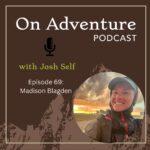
If you had told me, when I started the On Adventure podcast, that two of my favorite recent conversations would be with a long-distance hiker who walked the equivalent of more than four cross-country trips in a single calendar year and a Midwestern dad who built a thriving business around airline points, I would have raised an eyebrow. On paper, they have almost nothing in common. But spend an hour with each of them and you start to hear the same note ringing underneath the very different music.
Madison Blagden and Colin Stroud both did something that scared them. They both stepped off a well-marked path. And they both came back changed – not because of the mileage or the revenue, but because of what those experiences taught them about who they actually are when the safety rails come off. I think there is a lot in their stories that the everyday explorer – and frankly, the everyday investor – can put to work this week.
Madison: Walking 10,000 Miles, Planning Almost None of It
Madison Blagden spent last year on her feet. Through-hiking the Appalachian Trail, the Pacific Crest Trail, and the Continental Divide Trail in a single calendar year is itself an audacious goal – only a handful of people have ever done it. Madison didn’t stop there. She set her bar at over 10,000 miles, walking from Florida to Newfoundland and weaving the three big trails together into a feat that no woman had previously completed. She finished. She also raised the women’s record by a couple thousand miles in the process.
What surprised me most, though, was not the scale of the accomplishment. It was her relationship to planning. Here is someone who built her year around weather windows, snowpack, and resupply logistics – and her advice to anyone considering something hard was, in her words, plan as little as you have to. Whatever you think it will cost, double it and save that much. Then go.
Her reasoning is worth sitting with. So many things will happen that you cannot predict, she said, that the energy you spend trying to control them is energy you will need later for the things you actually have to face. The hikers who do best on a long trail are the ones who can pivot – who do not get emotionally locked into a schedule or a route. The ones who white-knuckle a plan tend to suffer more, finish ragged, or quit. Madison described last year’s mid-season injury as the moment she finally let go of the last bits of control she was still holding. From that point forward, every setback, every weather change, every wrench in the gears became something she just folded into the trip.
If you have ever opened a financial plan and felt the urge to nail every variable to the wall – the exact return, the exact retirement date, the exact tax outcome – Madison’s advice translates directly. A good plan is a flexible one. Whatever you think things will cost, plan for more. Then walk.
Colin: The Quiet Quit That Wasn’t Quiet at All
Colin Stroud’s adventure looks nothing like Madison’s, and that is the point. A few years ago, Colin was sitting in an insurance brokerage in Indiana, watching his wife and two of his brothers-in-law build real audiences on the internet. He was good at his job, but it bored him, and he had been passed over for a promotion he wanted. Around the same time, he had stumbled into the world of credit card points and travel rewards as a way to take his young family on a vacation they otherwise could not afford. He started writing about it on LinkedIn, mostly to see if anyone would care.
They cared. The Washington Post quoted him after one of his earliest posts. People started asking if he would get on the phone for an hour to walk through their points strategy. He charged forty-five dollars. Then a little more. Then more. About fifteen months later, he resigned from his W-2 job and went all in on a one-person consulting practice he calls Go Somewhere. Today he is running consulting calls, building a private community for business owners, and partnering with another points expert to scale a white-glove travel-research service. He does not yet know how big it gets. He does know that nothing in his prior career – the standardized tests, the promotions he did not get, the jobs he was not great at – comes close to what he is feeling right now.
What hooked me in our conversation was Colin’s description of why entrepreneurship lit him up the way it did. It was not the income, though the income matters. It was the daily measurement. Every day he gets feedback on whether he is where he thought he was. Every post, every sales call, every new client tells him something true about his actual capability. He used the word ikigai – that overlap of what you love, what you are good at, and what people will pay you for – and said for the first time in his life, every part of him feels activated at once.
Colin also said something I want every entrepreneur and every parent listening to this to take seriously. He has experienced more dopamine, more excitement, more flow from building this business than from any travel destination he has ever been to. And his family life, while quieter, is the most meaningful thing he does. Travel, in other words, is not the adventure. The adventure is the life he is building around the people he loves. The travel is just a way to bring them with him.
What the Everyday Explorer Can Take Home
Different as they are, Madison and Colin pointed me toward the same three lessons, and I think they apply just as much to the way we manage money and build a life as they do to long trails and online businesses.
The first is that uncertainty is not the enemy. It is the proof that you are doing something real. Madison built her year around variables she could not control. Colin walked away from a paycheck without knowing what would replace it. In both cases, the willingness to live with not-knowing was what unlocked the experience. We tend to treat uncertainty in our financial lives as a thing to be eliminated. It cannot be. The better question is whether your plan can absorb a surprise without breaking – and whether you have left yourself enough margin, financially and emotionally, to keep walking when the weather turns.
The second is that the people who do the most talk about it the least. Madison observed that on trail, the loudest people in the room have usually done the least. The ones with the real accolades sit quietly in the corner. I have seen the same dynamic in money. The truly wealthy people I have worked with rarely tell you anything about it. The ones loudly counting their wins are usually the ones with the most to prove. If you are doing the work, the work will speak. You do not have to.
The third – and this is the one that has stuck with me longest – is that the cliff edge is the whole point. When I asked Madison what she would say to someone standing on the edge of a decision that scared them, her answer was just, do it. Not because every adventure works out. Some do not. But because nobody she has met in the trail community regrets going and finding out it was not for them. The ones with regret are the ones who stayed home. Colin’s version of the same line was that everyone has a hundred-thousand-dollar idea sitting in their Google Drive, and most people will never act on it.
You probably have a version of this too. A trip you have been talking about for five years. A career move you keep telling yourself you will make next year. A conversation you have been avoiding. A plan you have been afraid to commit to on paper. The everyday explorer is the person who, knowing they cannot control the outcome, takes the next step anyway – and trusts that whatever shows up next, they will figure out how to keep walking.
That, more than anything else, is what I keep hearing from the guests on this podcast. And it is the kind of mindset I want for the people I am lucky enough to work with at Ridgeline. A flexible plan. A long view. The honesty to admit you cannot know everything in advance. And the willingness to walk into the unknown anyway, because the alternative – staying parked at the trailhead, indefinitely – is not actually safer. It is just stiller.